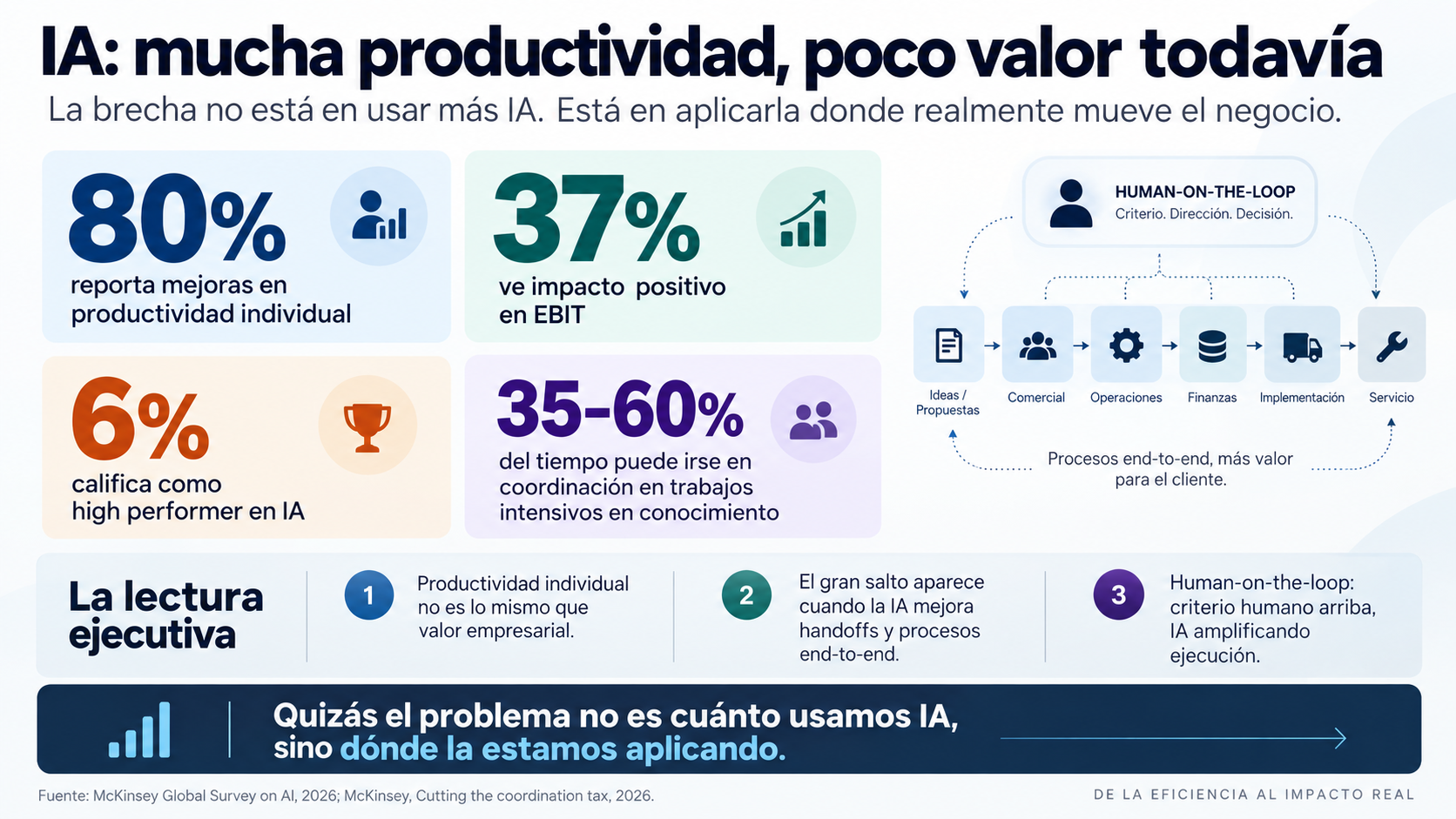
Two numbers are hard for me to ignore. Eighty percent of respondents in a McKinsey survey say AI improved their individual productivity. Yet only 37% attribute a positive impact on their organization's EBIT to AI. That gap is enormous. Perhaps the question is not how much AI we use, but where we apply it.
We have learned to write faster, summarize, prepare presentations, analyze information and automate reports. All of that helps. But an organization is not a collection of isolated tasks. It is an end-to-end system: customer, sales, operations, finance, service, decisions, approvals and handoffs. Often the real cost lies between tasks: waiting, asking for the same information again, a stalled approval, a change in data format or a decision nobody truly owns.
McKinsey estimates that coordination can consume 35% to 60% of working time in knowledge-intensive organizations. This is where I see a much larger opportunity for AI: redesigning how work flows, rather than merely accelerating the existing process.
That changes the business leader's role. The greatest value is not producing more emails or reports with AI. It is leading better: seeing sooner, detecting deviations, connecting information, preparing scenarios, assigning resources, removing obstacles and making decisions. Then stepping in personally when judgment is needed.
This is why I like the idea of a human on the loop. AI can operate within many loops. The leader stays above them, defining purpose, boundaries, risks and exceptions, watching for signals and intervening when a decision requires context, judgment or accountability.
The divide will probably not be between young and old, or even between AI users and non-users. It will be between those who use AI to do existing tasks faster and those who redesign the way an entire organization works and decides. Individual productivity is valuable. But if it does not become better decisions, less friction or stronger results, an important part of the work remains. The real opportunity starts when efficiency becomes value.
Sources cited in the original: McKinsey, The State of AI in 2026 and Cutting the Coordination Tax, September 2026.